

TL;DR:
- One interruption costs over 23 minutes of full focus, significantly reducing productivity.
- Frequent task switching increases errors and decreases memory retention by up to 27%.
- Strategies like batching tasks and silencing notifications can help protect deep focus and improve efficiency.
One interruption can quietly steal more than 23 minutes of your focus. Research shows it takes an average of 23 minutes and 15 seconds to fully refocus after a single disruption, yet most students and young professionals switch tasks dozens of times a day without realizing the toll. The belief that juggling multiple things at once means getting more done is one of the most persistent myths in productivity culture. This guide breaks down the real science behind task switching, shows you exactly what it costs, and gives you practical strategies to protect your focus and actually move the needle.
Table of Contents
- What is task switching and why do we do it?
- The hidden costs: Productivity loss, errors, and memory decline
- How task switching affects your brain and stress levels
- When is switching tasks actually helpful?
- Practical strategies to minimize task switching
- The uncomfortable truth about productivity myths and task switching
- Take your focus further with the right tools
- Frequently asked questions
Key Takeaways
| Point | Details |
|---|---|
| Switching costs focus | It takes over 23 minutes to return to deep work after every interruption. |
| Productivity and errors | Frequent task switching slashes productivity by up to 40% and raises error rates, especially during complex work. |
| Batch and block | Grouping similar tasks and scheduling focused work sessions are proven strategies to minimize switching losses. |
| Only switch with intention | Strategic switches can help when energy is low, but indiscriminate switching increases fatigue and stress. |
| Practical tools help | Task management apps and time-tracking solutions make it easier to stay single-tasked and keep distractions at bay. |
What is task switching and why do we do it?
Task switching means shifting your attention from one task or context to another before the first one is finished. It sounds harmless, maybe even efficient. But every time you move from writing a paper to checking Slack, then to answering an email, your brain pays a price called the switch cost, which is the mental effort and time lost when changing focus.
So why do we do it so often? A few forces are working against you:
- Constant notifications from phones, apps, and email create a near-constant pull on your attention.
- Urgency culture in academic and professional settings rewards fast responses over deep work.
- Workplace and classroom expectations often require you to manage multiple projects or conversations at once.
- The illusion of progress makes switching feel productive, even when it isn’t.
The myth that multitasking boosts output is stubborn. Many students believe handling several things simultaneously proves efficiency. In reality, the brain doesn’t truly multitask. It rapidly toggles between tasks, and that toggling has a measurable cost. Effective time management skills actually depend on protecting your attention, not dividing it.
Not all switches are equal, though. Shifting from one low-stakes routine task to another costs far less than jumping from a complex analysis to a creative writing assignment. The more cognitive demand involved, the steeper the penalty. Understanding this distinction is the first step toward smarter scheduling and batching tasks for productivity in ways that actually work.
“The brain is not designed to handle multiple high-demand tasks at once. Every switch forces a mental reset that drains time and energy you can’t get back.”
The long-term effects go beyond just feeling scattered. Frequent switching trains your brain to expect constant novelty, making it harder to sustain deep focus even when you want to.
The hidden costs: Productivity loss, errors, and memory decline
Seeing the numbers makes the risk concrete. Productivity drops by up to 40% when you switch tasks frequently. That’s nearly half your potential output gone, not because you’re working less, but because your brain keeps resetting.
Error rates tell an equally alarming story. Mistakes increase by up to 40% during frequent task switching, especially on complex work. For a student writing a research paper or a professional preparing a report, that means more revisions, more time, and more frustration.
| Impact area | Effect of frequent task switching |
|---|---|
| Productivity | Up to 40% reduction |
| Error rate | Up to 40% increase |
| Memory retention | 27% lower vs. single-tasking |
| Refocus time | 23 min 15 sec per interruption |
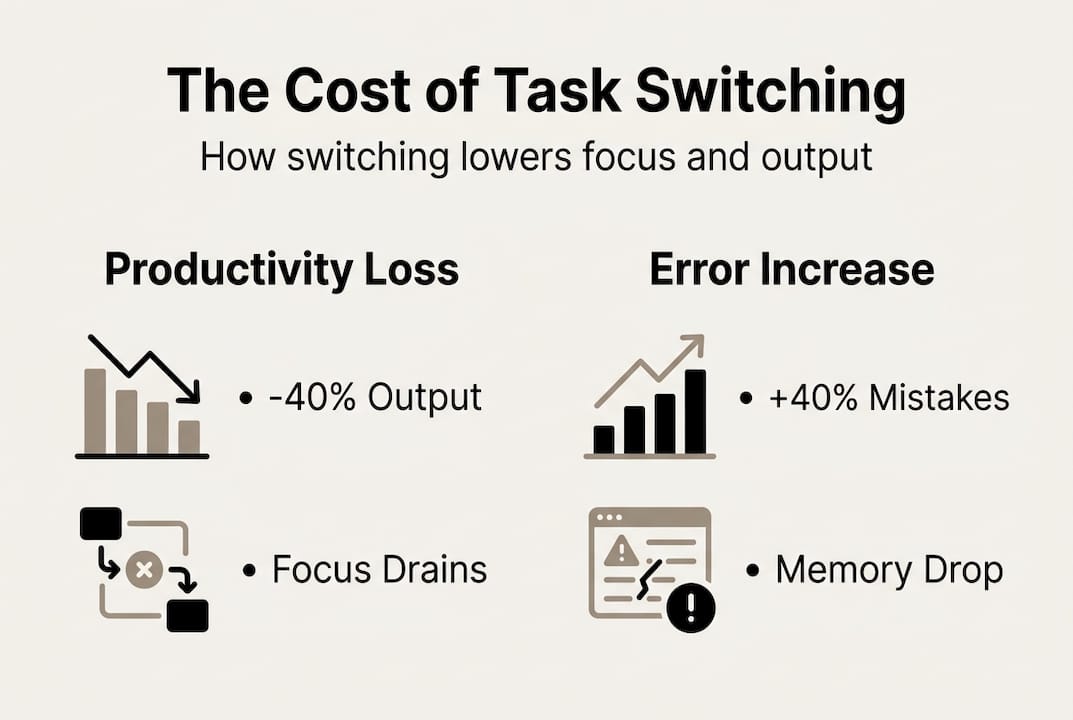
Memory and comprehension take a hit too. Students retain 27% more when they single-task compared to studying with frequent interruptions. That means every time you study while texting or flipping between tabs, you’re actively weakening what you’re trying to learn. Strategies like micro-tasking for improved retention exist precisely because focused, small bursts of effort outperform scattered longer sessions.
Key signs that task switching is hurting you:
- Assignments take much longer than they should
- You feel mentally drained well before the day ends
- You re-read the same paragraph multiple times
- Small mistakes keep appearing in your work
- You can’t remember what you were doing before an interruption
The effect on cognitive fatigue is real and cumulative. Each switch adds a small tax, and by the end of a switching-heavy day, your mental energy is depleted long before your task list is. Tracking your productivity goals examples becomes nearly impossible when your baseline performance keeps shifting.
Stat to remember: A single interruption costs you 23 minutes and 15 seconds of full focus. Switch tasks five times in a morning, and you’ve potentially lost nearly two hours of deep work.
How task switching affects your brain and stress levels
Here’s what actually happens inside your brain when you switch tasks. Your prefrontal cortex, the region responsible for planning and decision-making, has to disengage from one set of rules and load an entirely new set. This process isn’t instant. It burns glucose, strains working memory, and triggers a stress response.

Mechanisms like attention residue, prefrontal cortex overload, glucose depletion, and elevated cortisol all contribute to why switching feels so draining. Attention residue, a term coined by researcher Sophie Leroy, describes how part of your mind stays stuck on the previous task even after you’ve moved on. You’re physically present on the new task, but mentally you’re still partially somewhere else.
Here’s how the cycle typically plays out:
- You start a complex task and build momentum.
- A notification or interruption pulls your attention away.
- You switch to the new demand, but residue from the first task lingers.
- Your cortisol level rises slightly, adding low-grade stress.
- Returning to the original task requires a full mental reload.
- Fatigue sets in faster than it would have with uninterrupted focus.
The practice and preparation research shows that preparation before a switch can reduce, but never fully eliminate, the cost. Knowing you’ll need to switch later actually helps your brain prepare a handoff, but it still takes a toll.
Pro Tip: Before switching tasks intentionally, write down exactly where you are and what the next step is. This “brain dump” shortens the reload time when you return.
Exploring productivity techniques that account for these mental mechanics, like time blocking or deep work sessions, can dramatically reduce how often your brain has to pay this switching tax.
When is switching tasks actually helpful?
Not every task switch is a disaster. The latest research reveals some genuinely useful exceptions, and knowing them helps you switch smarter rather than just switching less.
Strategic switching from complex to routine tasks can reduce depletion when your mental energy is already low. Think of it as a gear shift. When you’ve been deep in a difficult project for 90 minutes and your focus starts to fade, moving to a low-stakes task like organizing your notes or answering a simple email can actually restore some energy.
Here’s the key distinction research highlights: switching is beneficial after low-efficacy periods, but detrimental after high-efficacy ones. In plain terms, switch when you’re running low, not when you’re in the zone.
| Switching scenario | Likely outcome |
|---|---|
| After 90 min of deep focus | Detrimental, breaks momentum |
| After low-energy, scattered work | Beneficial, resets engagement |
| Routine to routine | Low cost, manageable |
| Complex to complex | High cost, significant fatigue |
Beneficial switch conditions:
- You’ve been stuck on the same problem for over 20 minutes
- Your attention is already fragmented and unfocused
- The next task is low-stakes and familiar
- You’re using the switch as a deliberate reset, not an escape
Pro Tip: Use natural energy dips, usually mid-afternoon, for routine admin work like replying to messages, filing documents, or reviewing your calendar. Save your peak hours for the work that actually requires deep thought.
Using prioritization for student productivity frameworks helps you map your tasks to your energy levels, so you’re not wasting your sharpest hours on low-value work. The attention span podcast from the American Psychological Association digs deeper into how attention works and why timing matters.
Practical strategies to minimize task switching
Knowing when it’s okay to switch, here’s how to actively redesign your routine to keep harmful switches to a minimum.
Step-by-step approach to low-switching days:
- Batch similar tasks together. Group emails, readings, or writing sessions into dedicated blocks so your brain stays in one mode longer. Task batching for students is one of the most research-supported methods for reducing cognitive load.
- Block time on your calendar. Assign specific hours to specific task types. Treat focus blocks like meetings you can’t cancel.
- Silence notifications during focus blocks. Turn off all non-essential alerts. Even a visible notification, one you don’t act on, pulls attention.
- Use a physical or digital cue to start focus mode. A specific playlist, a closed door, or an app blocker signals to your brain that switching is off the table.
- End each session with a handoff note. Write the next action before you stop. This reduces the reload cost when you return.
Task batching, time blocking, and the Pomodoro Technique are the primary methods proven to cut switching costs. The Pomodoro method uses 25-minute focused sprints followed by short breaks, which naturally limits unplanned switching.
Quick wins you can start today:
- Check email only at set times, not continuously
- Use one tab or app per focus session
- Keep a “parking lot” list for ideas that pop up mid-task
Pro Tip: Experiment with 25, 60, and 90-minute focus intervals to find your personal sweet spot. Some people hit peak output at 25 minutes, others need 90 to reach deep flow. There’s no universal answer, so test and track your results.
Exploring productivity hacks and organization tools for students can help you build these habits faster with the right systems in place.
The uncomfortable truth about productivity myths and task switching
Here’s something most productivity content won’t say directly: hustle culture has made multitasking a status symbol. Saying “I’m juggling five projects” sounds impressive. Saying “I work on one thing at a time” sounds slow. But decades of research say the second person is getting more done.
We’ve built workplaces and academic environments that reward visible busyness over actual results. Responding to every message instantly, attending every meeting, staying constantly available. These behaviors look productive but systematically destroy the conditions needed for deep, meaningful work.
The students and professionals who consistently produce their best work aren’t the ones doing the most at once. They’re the ones who protect their attention ruthlessly. One Centurion we’ve spoken with cut their assignment completion time nearly in half simply by turning off notifications and working in 60-minute blocks. No new tools, no extra hours. Just fewer switches.
Strategies like focus with micro-tasking work not because they’re clever tricks, but because they align with how your brain actually operates. The uncomfortable truth is that doing less at once is how you accomplish more overall.
Take your focus further with the right tools
If you’re ready to put these ideas into action, the right tools can make low-switching, high-focus routines effortless.
Optio is built specifically for Centurions like you, students and young professionals who need a second-in-command to manage tasks, time, and priorities without the chaos of constant context switching. From structured task batching to focus-friendly scheduling, Optio keeps your mission organized so your brain doesn’t have to do the heavy lifting. Check out the best task management software guide to compare your options, learn how to keep track of tasks at work, and discover exactly how to manage tasks effectively with systems designed for real focus.
Frequently asked questions
How much time do I really lose when I switch tasks?
On average, it takes 23 minutes and 15 seconds to return to full focus after each interruption, meaning even a quick distraction carries a steep hidden cost.
Can switching tasks sometimes improve productivity?
Strategic switches to routine tasks after mental fatigue can refresh your energy, but frequent or unplanned switching still harms overall performance.
What are the best ways to reduce task switching?
Group similar tasks through batching, set specific focus time blocks, and silence notifications. Task batching, time blocking, and the Pomodoro Technique are the most research-supported starting points.
How does task switching impact learning for students?
Task switching cuts memory retention and comprehension, while single-tasking can improve retention by 27%, making focused study sessions significantly more effective than distracted ones.
Recommended
- Task Batching Explained: Boost Focus and Productivity – Optio Station: Best Project Management App for Prioritization
- Essential productivity hacks for students and young pros – Optio Station: Best Project Management App for Prioritization
- 7 Time Management Goals for Employees Examples to Boost Productivity – Optio Station: Best Project Management App for Prioritization
- Micro-Tasking: Boosting Focus for Busy Students – Optio Station: Best Project Management App for Prioritization
