

Time slips away faster than most people realize and nearly everyone feels the crunch to get more out of each day. Yet here’s something that surprises many: Chronic disorganization and poor time management can actually increase stress, anxiety, and the feeling of being overwhelmed. Most people think time management just means organizing a calendar, but it is really the key that unlocks both productivity and personal well-being in ways you might not expect.
Table of Contents
- What Is Time Management And Its Key Components?
- Why Time Management Matters For Students And Professionals
- How Time Management Affects Productivity And Mental Health
- Theoretical Foundations Of Time Management Concepts
- Real-World Applications Of Time Management In Daily Life
Quick Summary
| Takeaway | Explanation |
|---|---|
| Understand the value of your time | Recognizing how to allocate your limited hours is key to productivity and achieving goals. |
| Prioritize tasks effectively | Focus on urgency and importance to make efficient decisions and enhance results. |
| Implement structured scheduling | Create clear plans for daily activities to minimize chaos and improve task management. |
| Identify time-wasting activities | Recognize distractions that hinder productivity and develop strategies to minimize them. |
| Embrace flexibility in planning | Adapt your strategies to align with your productivity patterns for better results. |
What is Time Management and Its Key Components?
Time management represents a strategic approach to organizing and controlling how you spend your time to maximize productivity and achieve personal and professional goals. At its core, time management goes beyond simple scheduling it is a comprehensive skill set that enables individuals to prioritize tasks, reduce stress, and create meaningful progress in their lives.
Defining Time Management
Time management is fundamentally about understanding the value of your time and making intentional choices about how you allocate your limited daily hours. According to EBSCO Research Starters, it involves planning, prioritizing, and scheduling tasks to enhance efficiency and effectiveness.
Key components of effective time management include:
- Prioritization of tasks based on importance and urgency
- Creating structured schedules
- Identifying and minimizing time-wasting activities
- Setting clear and achievable goals
- Developing consistent organizational strategies
Psychological Foundations of Time Management
Research published in BMC Psychology reveals that effective time management significantly influences personal engagement and self-control. This means that good time management is not just about completing tasks but about developing a psychological framework that enables better decision making and personal discipline.
Successful time management requires understanding your personal work rhythms, recognizing potential distractions, and creating systems that align with your natural productivity patterns. This approach transforms time management from a rigid set of rules into a flexible, personalized strategy for achieving your objectives.
By mastering time management, you gain more than just productivity. You create space for personal growth, reduce unnecessary stress, and develop a sense of control over your professional and personal life.
To clarify key aspects of effective time management, the table below breaks down its major components and their practical roles.
| Key Component | Description |
|---|---|
| Prioritization | Determining task importance and urgency to focus effort |
| Structured Scheduling | Establishing clear plans for daily and weekly activities |
| Minimizing Time-Wasters | Identifying and reducing activities that hinder productivity |
| Goal Setting | Defining clear, realistic goals to guide actions |
| Organizational Strategies | Creating routines and structures for efficiency |
| Flexibility | Adapting plans based on changing needs or patterns |
| The skill is not about working harder but working smarter, ensuring that your energy and attention are directed towards activities that truly matter. |
Why Time Management Matters for Students and Professionals
Time management transcends mere scheduling it is a critical skill that dramatically influences personal and professional success. For students and professionals alike, mastering this skill can mean the difference between merely surviving and truly thriving in competitive environments.
Performance and Academic Achievement
Research involving multiple studies demonstrates the profound impact of time management on performance. In academic settings, effective time management correlates directly with higher grades and improved grade point averages. Professionals across various sectors experience similar benefits, with enhanced time management leading to measurable improvements in workplace productivity.
Key performance benefits include:
- Increased efficiency in task completion
- Better quality of work output
- Reduced stress and burnout
- More consistent achievement of personal and professional goals
- Enhanced ability to handle complex projects
Psychological and Motivational Implications
Beyond tangible performance metrics, time management plays a crucial psychological role. Research with college students reveals that strong time management skills directly influence study engagement and self-control. This suggests that the ability to manage time effectively is not just about external productivity but also about internal psychological well-being.
Professionals who develop robust time management strategies often experience:
- Greater sense of personal control
- Improved self-confidence
- Reduced anxiety about deadlines
- More balanced work-life integration
For those looking to dive deeper into productivity strategies, check out our ProductivityThoughts guide on mastering time management techniques.
Ultimately, time management is a transformative skill that empowers individuals to take control of their professional and personal trajectories. It is not about working more hours, but about working smarter, making intentional choices that align with one’s goals and values.
The following table highlights the psychological and practical benefits of strong time management skills for both productivity and mental health.
| Benefit Area | Time Management Impact |
|---|---|
| Productivity | Greater efficiency, better task prioritization, improved outcomes |
| Stress Reduction | Less feeling of overwhelm, increased predictability |
| Self-Control | Enhanced discipline, better focus, decreased procrastination |
| Personal Agency | More control over choices, improved work-life balance |
| Confidence | Higher self-assurance from achieving goals and meeting deadlines |
How Time Management Affects Productivity and Mental Health
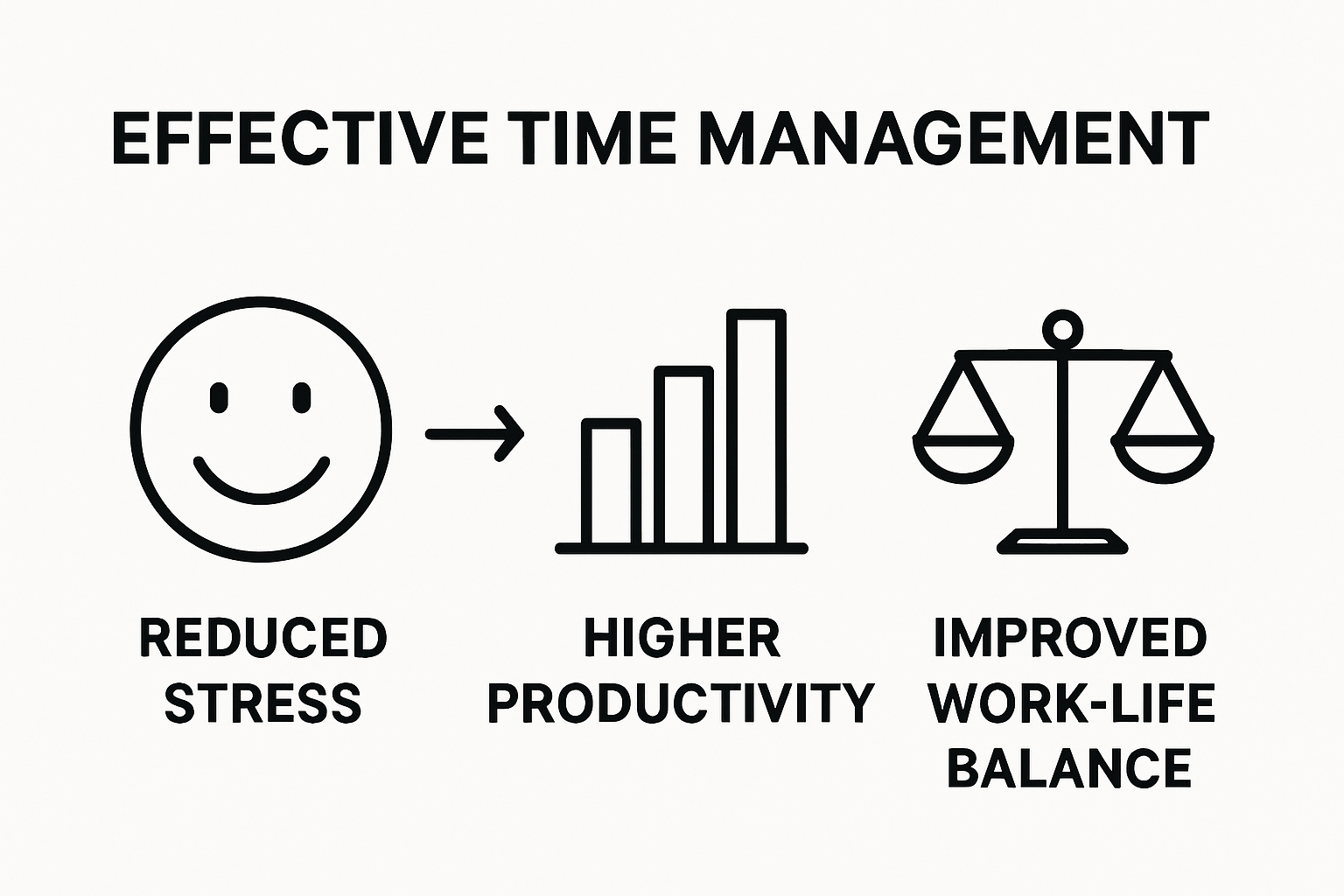
Time management serves as a critical bridge between personal performance and psychological well-being. Far from being a simple organizational tool, it acts as a powerful mechanism that directly influences both productivity and mental health, creating a complex interplay between how we structure our time and our overall psychological state.
The Productivity Connection
Research published in BMC Public Health reveals that effective time management skills dramatically predict increased productivity and reduced perceived stress. By creating structured approaches to task completion, individuals can transform their work experience from chaotic and overwhelming to systematic and controlled.
Key productivity benefits of strategic time management include:
- Clearer prioritization of tasks
- Reduced time spent on unnecessary activities
- More consistent goal achievement
- Enhanced ability to meet deadlines
- Improved quality of work output
Mental Health and Organizational Skills
Beyond productivity, time management plays a profound role in mental health. Chronic disorganization and poor time management can lead to increased anxiety, stress, and feelings of being overwhelmed. Conversely, developing robust time management strategies provides a sense of control and predictability that can significantly reduce psychological strain.
Mental health benefits associated with effective time management include:
- Lower stress levels
- Reduced performance anxiety
- Increased sense of personal agency
- Better work-life balance
- Enhanced self-confidence
For individuals seeking to explore more advanced productivity techniques, our ProductivityThoughts guide offers comprehensive insights into optimizing personal performance.
Understanding time management as more than a mere organizational skill reveals its true power. It is a holistic approach to living that connects external productivity with internal psychological well-being, enabling individuals to create more balanced, fulfilling lives by making intentional choices about how they spend their most precious resource time.
Theoretical Foundations of Time Management Concepts
Time management is more than a collection of practical techniques it represents a sophisticated psychological framework that integrates cognitive processes, behavioral strategies, and personal motivation. Understanding its theoretical foundations provides deeper insights into how individuals can effectively control and optimize their temporal resources.
Psychological Models of Time Management
ResearchGate scholars highlight several critical theoretical models that explain time management beyond surface-level organizational skills. These frameworks reveal time management as a complex interaction between psychological constructs like self-efficacy, personal beliefs, and goal-oriented behaviors.
Key psychological dimensions of time management include:
- Cognitive perception of time and personal capabilities
- Motivational frameworks driving task completion
- Self-regulatory mechanisms controlling behavior
- Personal belief systems about productivity
- Emotional intelligence in task prioritization
Behavioral and Cognitive Foundations
Time management operates at the intersection of psychological motivation and practical action. It is not merely about scheduling but about developing a comprehensive approach to understanding personal productivity. The theoretical frameworks suggest that effective time management involves complex cognitive processes that help individuals:
- Recognize personal strengths and limitations
- Create realistic and achievable goals
- Develop adaptive strategies for task management
- Understand personal energy cycles and productivity patterns
- Build resilience against procrastination and distraction
For professionals seeking to delve deeper into productivity strategies, our ProductivityThoughts guide offers comprehensive insights into advanced time management techniques.
Ultimately, time management theory demonstrates that managing time is a deeply personal and psychological journey. It requires self-awareness, strategic thinking, and continuous adaptation, transforming time from an external constraint into a personal resource that can be consciously shaped and optimized.
Real-World Applications of Time Management in Daily Life
Time management transforms from an abstract concept to a powerful tool when applied across various personal and professional contexts. Its principles extend far beyond simple scheduling, offering strategic approaches to navigating complex daily challenges and maximizing individual potential.
Professional and Academic Implementation
According to Rutgers University research, effective time management serves as a critical skill in enhancing workplace productivity and personal effectiveness. Professionals and students can leverage time management strategies to:
- Optimize project deadline estimations
- Prioritize complex tasks systematically
- Reduce unnecessary workplace stress
- Create more predictable workflow patterns
- Improve overall performance metrics
Personal Life and Daily Routine Integration
Time management is not confined to professional settings but represents a holistic approach to living. By implementing strategic planning techniques, individuals can transform their personal routines, creating more balanced and intentional lifestyles. This involves understanding personal energy cycles, recognizing productivity patterns, and developing adaptive strategies for managing daily responsibilities.
Practical applications in personal life include:
- Creating structured daily and weekly plans
- Setting realistic time limits for household tasks
- Managing personal fitness and health routines
- Balancing social commitments and personal goals
- Developing consistent self-improvement practices
For those seeking advanced productivity strategies, our ProductivityThoughts guide offers comprehensive insights into optimizing personal performance.
Ultimately, time management transcends mere organizational skill. It represents a profound approach to living deliberately, transforming time from an external constraint into a personal resource that can be consciously shaped, managed, and optimized for maximum personal and professional fulfillment.

Transform Insights Into Success With Optio Station
You just discovered how powerful time management can be for increasing productivity and reducing stress. But recognizing the importance of structure and prioritization is one thing. Turning those concepts into daily action can still feel overwhelming, especially if you face scattered tasks, looming deadlines, and the constant pressure to perform. Many students and young professionals struggle to turn theory into lasting habits. If you want to bridge the gap between understanding and real progress, it’s time to become a true Centurion of your own schedule. See practical strategies and inspiration in our ProductivityThoughts section.

Your success story starts with better habits today, not tomorrow. Optio Station can be your trusted second-in-command, helping you organize your goals and take control of every hour. Experience the app created just for you at Optio Station and unlock your full potential. If you want straight-to-the-point tips on managing both your time and mindset, take a look at our CenturionTips. Act now to finally manage your time instead of being managed by it.
Frequently Asked Questions
What is time management?
Time management is the strategic approach to organizing and controlling how you spend your time, maximizing productivity and achieving personal and professional goals.
Why is time management important for students?
Effective time management is crucial for students as it directly correlates with academic performance, enabling them to complete tasks efficiently and achieve higher grades while reducing stress.
How does time management affect mental health?
Good time management reduces feelings of stress and overwhelm, providing a sense of control and predictability, thus improving mental health and overall well-being.
What are key components of effective time management?
Key components include prioritization of tasks, creating structured schedules, minimizing time-wasting activities, setting clear goals, and developing consistent organizational strategies.
